





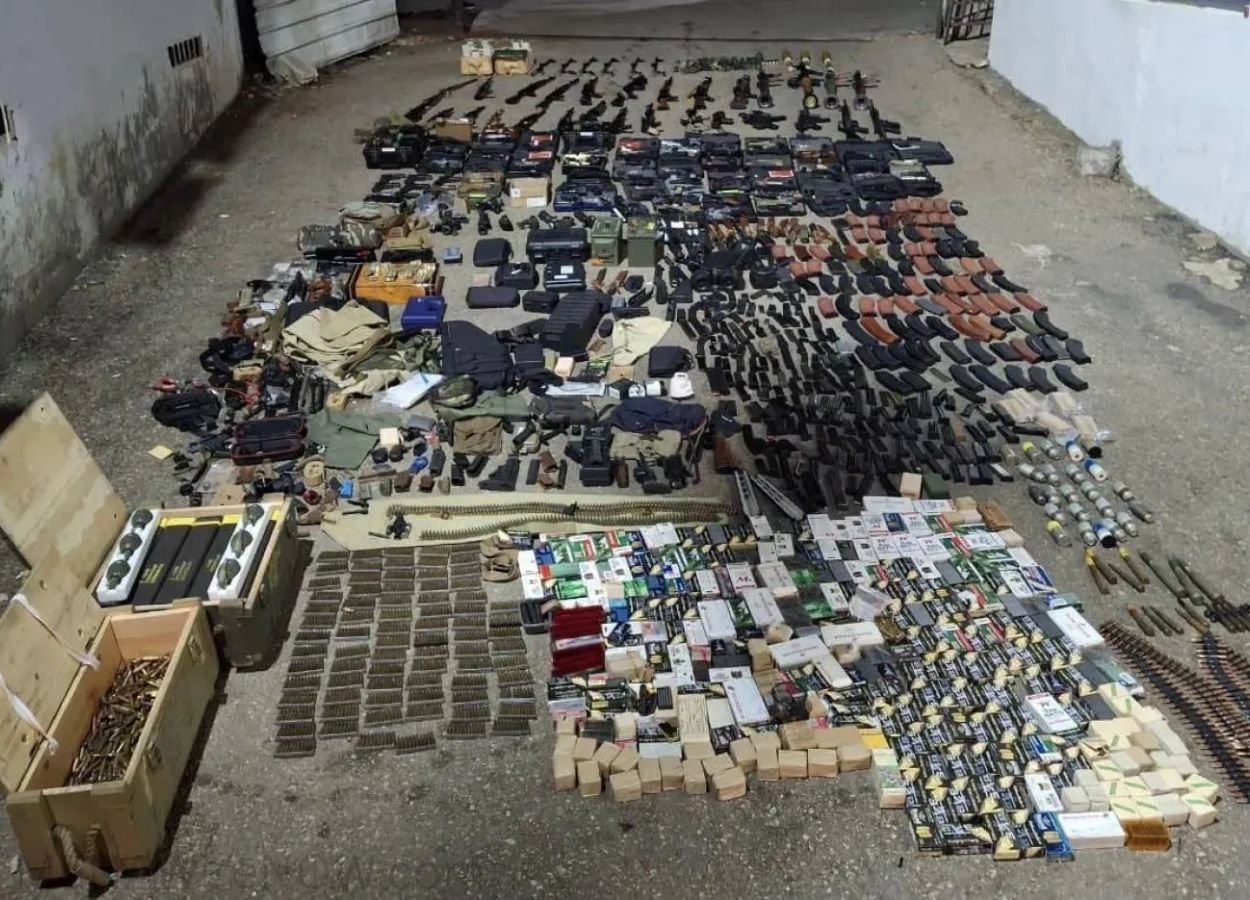
BEIRUT — Lebanese military forces confiscated a substantial stockpile of firearms and military munitions during an intelligence-led raid on a storage warehouse in the Musharrafieh neighborhood of Beirut’s southern suburbs. While the seized depot has not been linked to Hezbollah, the rare security operation inside the group’s traditional stronghold has reignited national debate regarding the Lebanese state’s push to assert an exclusive monopoly over weapons.
Military authorities reported that the intervention followed targeted surveillance tracking illicit arms trafficking and transportation networks. Soldiers apprehended one Lebanese national identified only by the initials “A.A.” and transferred the confiscated arsenal to specialized authorities for a judicially supervised inquiry. The official military communique omitted the identity of the property owner and avoided naming any political or armed faction. However, security information obtained by regional media indicates the warehouse belongs to a resident originating from the Chiyah area who fled into hiding immediately after the raid.
Retired Brigadier General Fadi Daoud characterized the intervention as a proactive, intelligence-driven enforcement measure rather than a reaction to a sudden security emergency. Speaking to Asharq Al-Awsat, Daoud emphasized that because the military strictly framed the case around illicit arms smuggling, no political faction can be blamed prematurely until judicial investigators conclude their work. He nonetheless warned that storing volatile munitions inside densely populated residential districts endangers civilian lives, adding that the raid projects a dual message—affirming state authority domestically while demonstrating military resolve to international observers following government decrees restricting arms to legitimate institutions.
A forensic examination of official photographs released by the military suggests the stockpile reflects commercial arms trafficking rather than strategic military supplies. Military affairs analyst Mustafa al-Asaad noted that the diverse assortment of weaponry points toward an experienced black-market dealer operating across multiple supply channels rather than foreign military shipments from Iran. Al-Asaad observed that while several handguns appeared to be legally imported models, others—specifically tan-colored Glock pistols resembling standard-issue sidearms used by Iraqi police, army, and special forces—may have been smuggled into Lebanon from Iraq via Syria, though serial number verification remains necessary.
The confiscated inventory also contained items appealing to private collectors alongside tactical gear, including a gold-plated Kalashnikov assault rifle, Skorpion submachine guns historically associated with targeted killings in the 1980s, hand grenades, explosive precursors, optical scopes, and night-vision devices. Contrasting the haul with heavy weaponry such as rocket launchers and anti-armor munitions previously seized during army operations in the Bekaa Valley, al-Asaad concluded that the Musharrafieh cache comprised standard black-market hardware rather than specialized battlefield armaments.





No Comment! Be the first one.