





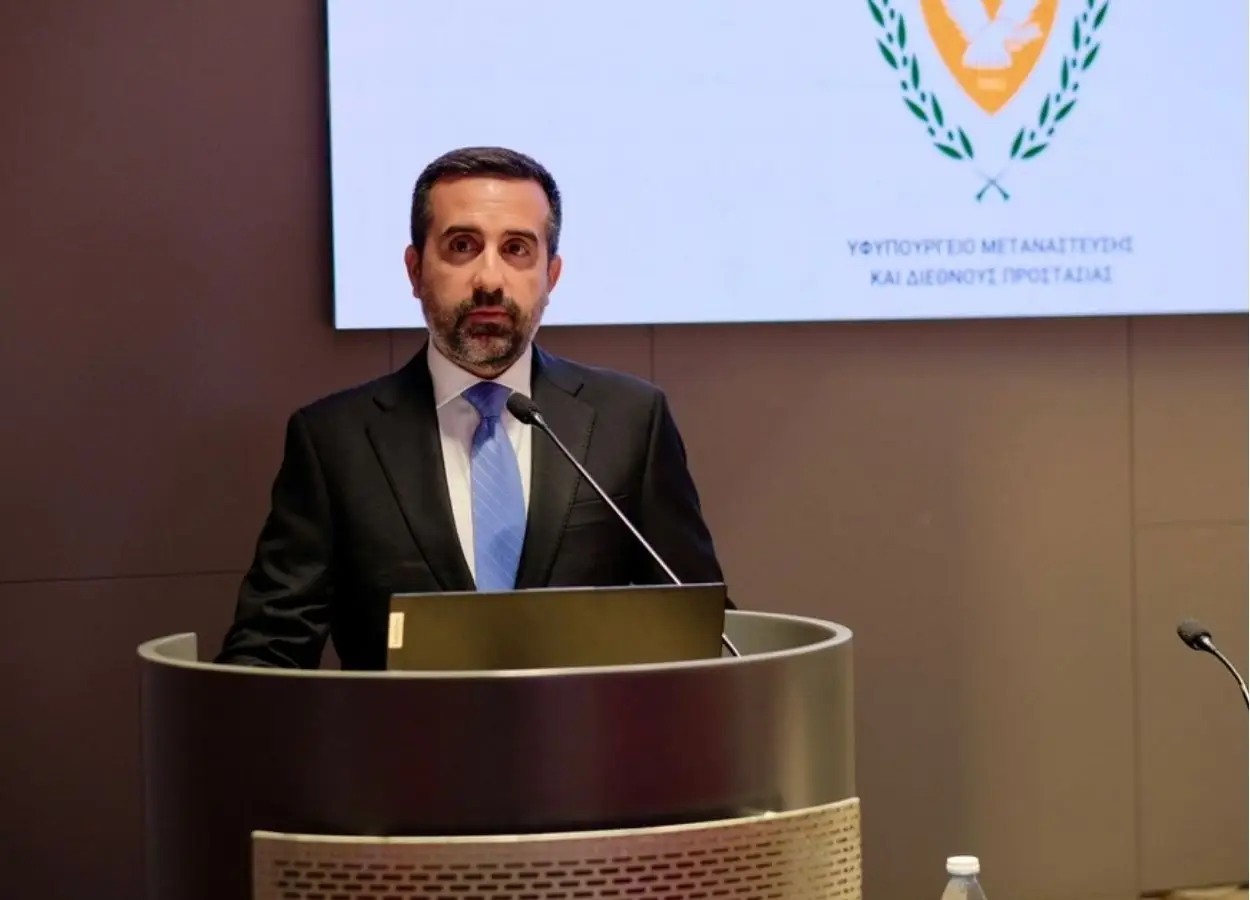
It is a great pleasure to be with you this afternoon for such an important forum on “The Future of Protection”.
At the outset, I would like to warmly thank the Mediterranean Migration and Asylum Policy Hub (MedMA) and its Director, Professor Karavias, for organising this timely and highly relevant event. I would also like to thank the School of Law of the University of Nicosia and its Dean, Professor Emilianides, for their kind hospitality.
We decided to place this event under the auspices of our Deputy Ministry for two main reasons. First, it is our intention to support academic events on issues of importance to the society. Second, the subject of today’s discussion lies at the heart of our mandate: how to preserve effective international protection in a period of growing instability, while building migration systems that are humane and functional.
But let me clarify this. We are not gathered here to question the value of international protection. On the contrary, we are here to discuss ways to make our systems more resilient, taking stock of the complexity of contemporary challenges.
Ladies and gentlemen,
For many years, migration in Europe was treated as a zero-sum game. Unfortunately, until recently, there was no coherent European strategy on migration. As a result, each member state relied primarily on its own national policies, adopting unilateral measures, taking into account solely its own interests.
This fragmented approach proved to be unsustainable. It was particularly unfair for frontline member states, like Cyprus and Greece, which, owing to their geographic location at the external borders of the Union, faced heavy migratory pressures. It also created space for criminal smuggling networks to exploit vulnerable people.
The 2015 refugee crisis demonstrated the limits of that model. It showed that no member state could manage effectively large-scale displacement, irregular movements, secondary flows and asylum pressure on its own.
It also revealed that Europe could not continue to respond through emergency measures, temporary solutions and ad hoc political compromises. Crisis-driven management can never be a permanent method of governance.
The lesson of 2015 was clear: migration is a shared European responsibility. Thus, the response must be collective.
Over the past decade, the European Union (EU) has gradually moved from fragmentation towards a more common approach. That shift has not been easy. It required difficult and protracted negotiations, institutional compromise and political courage.
Eventually, with the new Pact on Migration and Asylum, Europe has taken a decisive step.
The Pact is a comprehensive framework envisaging common rules intended to regulate migration and asylum at European level. It enshrines the key elements of the migration cycle: screening and border procedures, faster and more harmonised asylum procedures, clear rules on responsibility, crisis-management mechanisms, solidarity between member states, efficient returns.
In essence, the Pact aspires to strike a balance between the obligation to grant protection to those genuinely entitled to it on the one hand and the need to safeguard the vital interests of States on the other.
For Cyprus, the entry into application of the Pact is particularly significant. It occurred during the Cyprus Presidency of the Council of the EU, while migration was one of the central priorities of our Presidency. Moreover, as a frontline member state, Cyprus has consistently advocated a coherent and operational European system – one that does not leave border states to carry a collective European responsibility alone.
Nevertheless, the new edifice has now been put to the test. Member states, EU institutions and agencies are being called upon to turn legal provisions into operational reality.
Ladies and gentlemen,
A credible migration and asylum system also requires effective returns.
I would like to reiterate our firm stance on the matter. Asylum is provided to those who qualify for protection under international and European law. For those who do not have a legal right to remain, return is the only solution, always in conformity with human rights.
So far, return rates across Europe remain low. This has weakened public trust, encouraged misuse of asylum procedures and sent the wrong message to smuggling networks. If a negative decision has no practical consequences, the credibility of the entire system is undermined.
This is why the new EU Return Regulation is so important. It complements the Pact and brings us closer to a more coherent European return framework. It aims to make return procedures faster and more efficient, while maintaining legal safeguards.
It also strengthens cooperation both among member states and with third countries. Concepts such as “return hubs” have become part of the new apparatus. These tools must, of course, be utilised with caution and implemented in compliance with international law.
In this respect, it was a true honour and great responsibility for the Cyprus Presidency to lead the negotiations on behalf of 27 member states with the European Parliament and the Commission on the Return Regulation. Following months of hard work, we managed to deliver on this difficult task.
Ladies and gentlemen,
The future of protection also lies beyond our borders.
Migration does not begin at the external border of the EU. It commences along routes shaped by conflict, instability, persecution and organised crime. If we truly want to address migration effectively, we must delve into these thorny matters.
This is what we call “migration diplomacy”, and it entails deeper, comprehensive and continuous collaboration with countries of origin and transit. In other words, it is necessary to build mutually beneficial partnerships that address both European priorities and the needs of partner countries. Furthermore, we should work with them so as to combat smuggling networks and improve readmission cooperation.
Undoubtedly, migration policy is a multi-dimensional notion touching upon an array of issues such as foreign policy, security, development and economy.
The European policy we have been forging is all-encompassing. Rules on migration management at European level are necessary, but not adequate. A credible system requires strong external partnerships and a better understanding of the underlying reasons of migration.
At the same time, migration policy cannot only be about deterrence.
Europe faces labour shortages in key sectors. Our economies need talent, skills and mobility. Legal migration, if properly managed, can support European competitiveness, innovation and growth. It can also reduce pressure on asylum systems by offering realistic and transparent alternatives to irregular routes.
This is why legal pathways matter. Schemes such as the European Blue Card, the EU Talent Pool, skills partnerships and targeted bilateral cooperation can help establish orderly channels for mobility. But legal migration must be transparent, well-regulated and connected to real labour-market needs.
In Cyprus, we are also working in this direction. We recognise that legal migration can contribute to the economy and to key sectors. At the same time, we are investing in integration, given that lawful residence must be accompanied by participation, responsibility and respect for the host society.
Inevitably, integration is part of the future of migration. Language courses, skills development, access to lawful employment, civic orientation and familiarisation with the culture and values of the host society are central to social cohesion.
Ladies and gentlemen,
The future of protection will not be built on slogans or aphorisms. It should be contingent on functional systems.
This viewpoint permeates our migration strategy. In recent years, we have experienced significant pressure on our asylum system, reception capacity and public administration. We have responded through legal reform, enhanced coordination, increased returns, upgraded infrastructure, digitalisation and preparation for the implementation of the Pact.
Our decisive and targeted policy resulted in a sharp decline in irregular flows, while returns have soared. In particular, over the last three years, irregular flows have been reduced around 90% and approximately 35,000 third country nationals with no right to stay in Cyprus have been repatriated.
In addition, we have recently launched a new programme in order to facilitate the voluntary repatriation of Syrian nationals. Given the change of circumstances in the neighbouring country, many Syrians do not fulfil the criteria to attain international protection anymore. Against this backdrop, we offer Syrians residing in Cyprus an opportunity to return to their country in a safe and dignified manner. In this context, they receive sufficient financial assistance that will enable them to restart their lives in Syria.
In a nutshell, our objectives are clear: to prevent irregular migration and the abuse of asylum procedures; to protect those who genuinely need international protection; to return those who do not have the right to stay; to support lawful migration where it serves economic and social needs; and to preserve social cohesion, public order and national security.
The Pact is not perfect. No legal framework is. Difficulties will arise. Adjustments will be needed. Some systems will be tested under pressure. But it would be premature to dismiss the Pact from the outset.
For the first time, Europe has devised a common migration and asylum management system. It provides us with tools we lacked before. It replaces the logic of emergency improvisation with a more solid structure and streamlined procedures.
Now the task is to deliver.
This is why today’s discussion is important. It brings together legal expertise, policy experience, international perspectives and practical knowledge. It allows us to think not only about what protection meant in the past, but what it must entail in the years ahead.
I very much look forward to the discussion that will follow and to the contributions of the distinguished panellists. Their expertise will help enrich this debate about the future of protection.
Let me conclude with this thought.
International protection must remain at the heart of Europe’s identity. But to preserve it, we must render our systems credible and effective. We must protect those in genuine need and act firmly against abuse and criminal exploitation. It is necessary to cooperate with partners beyond our borders and create lawful alternatives. Most importantly, we must regain the trust of our citizens by proving that migration is managed according to strict rules, fundamental values and democratic accountability.
The future of protection is not less protection. It is adequate and meaningful protection within a more rational framework.
This is the direction in which both Cyprus and Europe move and should continue to do so.
Thank you.
Source: Link





No Comment! Be the first one.