





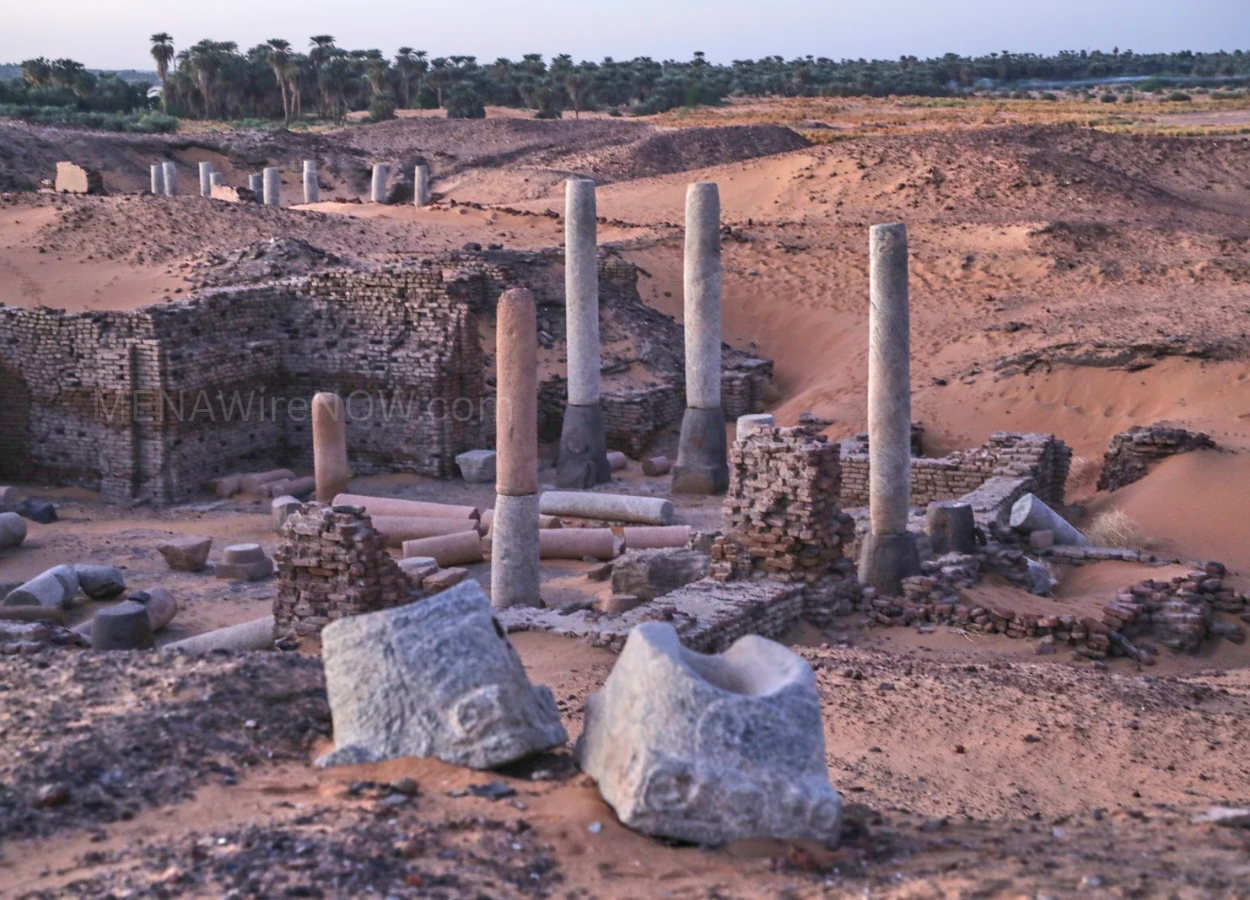
An international team of archaeologists has uncovered the original floor level of a huge mediaeval Christian church in northern Sudan, thus shedding new light on the architectural tradition of ancient Nubia.
The discovery was made by the Polish-Sudanese expedition in Old Dongola, located on the right bank of the Nile River, about 160 kilometres southeast of modern-day Dongola. The team of specialists managed to reach the original floor of the Great Church of Jesus of the seventh century AD through an ascending staircase surrounded by high walls 11 metres tall. Known since 2021, when it was first mentioned during the research, the cathedral has been buried under thick layers of sand for centuries, thus making this discovery a remarkable event in local studies.
Scholars leading the excavation emphasize that the sprawling scale of the religious complex surpasses the footprint of the White House. Spatial estimates suggest the structure spans roughly 47 meters in width and stretches 57 meters in length, positioning it securely as the most monumental Christian sanctuary constructed across medieval Makuria, one of three kingdoms that flourished in the region.
Historical context indicates that Old Dongola served as a vital political and cultural focal point following the arrival of Christian missionaries across the middle reaches of the Nile during the sixth century. Researchers note that the grand design and sophisticated building methods utilized in the sanctuary draw direct comparisons to architectural masterpieces like the Hagia Sophia in Istanbul—commissioned by Byzantine Emperor Justinian in 537—acting as an influential architectural trendsetter across northeastern Africa.
Artur Obłuski, who heads the joint excavation mission and directs the Polish Center of Mediterranean Archaeology, confirmed that specialists plan to systematically clear the remaining buried sections of the landmark. Further digging is expected to clarify the structural integrity, spatial layout, and artistic ornamentation preserved beneath the desert sands, shedding new light on how religious and political institutions shaped the region during the medieval era.





No Comment! Be the first one.