






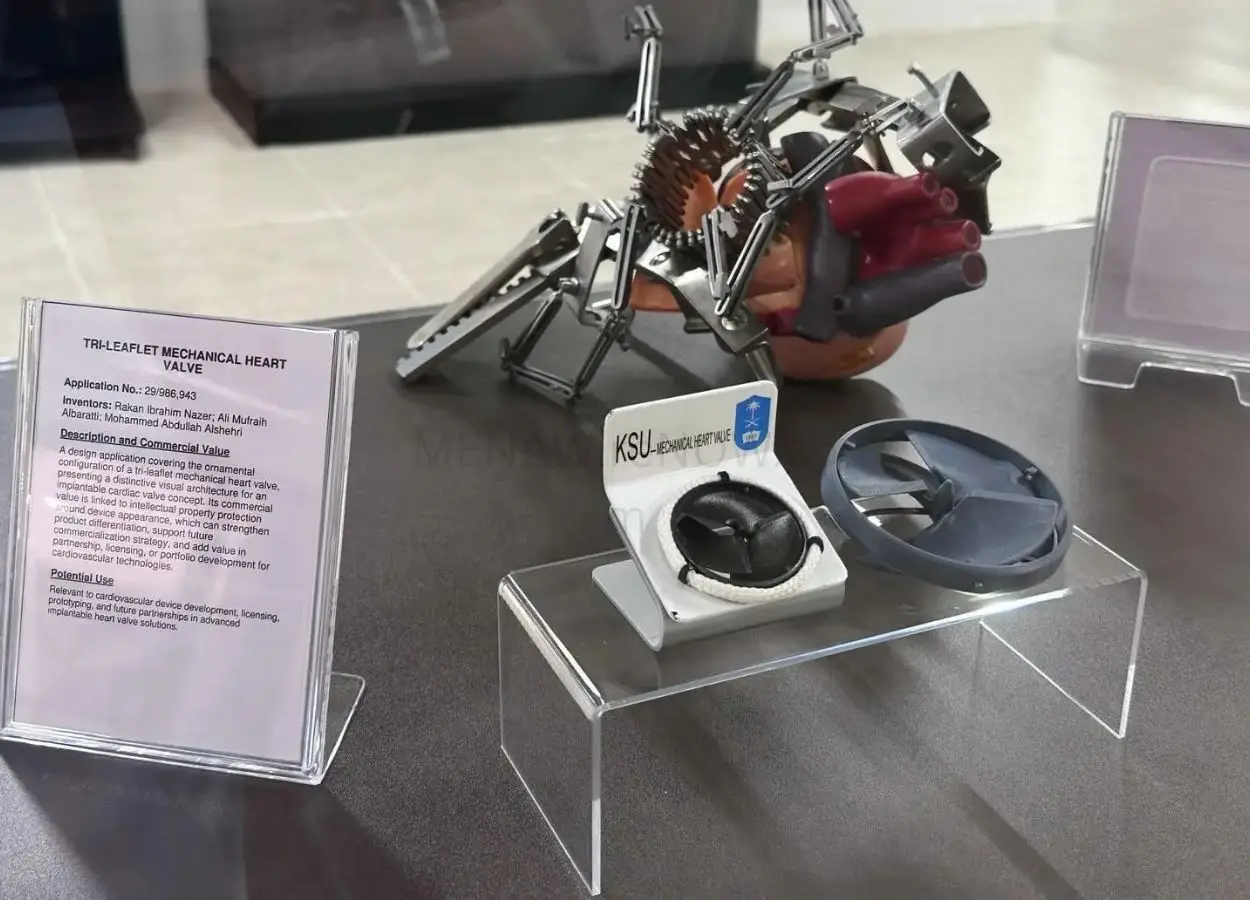
King Saud University in Saudi Arabia has secured a United States patent for a newly developed three-leaflet mechanical heart valve, marking another milestone in the university’s medical research and innovation efforts. The device was developed by Dr Rakan bin Ibrahim Nazer, a professor of cardiac sciences at the university’s College of Medicine.
The patented design introduces a mechanical configuration intended to improve the coordinated movement of valve leaflets, which regulate the passage of blood through the heart. Its structure incorporates three movable leaflets linked to a central mechanism and an outer ring, allowing the components to work together during opening and closing.
The development focuses on the mechanics of valve movement and the dynamics of blood flow. These factors are important in artificial heart valve design, where controlled movement and effective closure help maintain the direction of circulation and limit the backward leakage of blood.
According to the university’s description of the invention, the arrangement offers a different approach to conventional mechanical valve configurations. Its design centres on optimising leaflet motion and blood-flow behaviour, two considerations in the engineering of devices intended to replace or support the function of damaged heart valves.
Mechanical heart valves are used in certain patients who require replacement of a diseased or damaged natural valve. Their function is to maintain blood flow in the correct direction as the heart pumps. The movement and closure of the valve components are therefore important aspects of their design.
The three-leaflet configuration developed at King Saud University brings these engineering considerations together in a single mechanism. The three movable components are connected to a central assembly and a surrounding ring, creating a system designed to coordinate their movement during each opening and closing cycle.
The university has described the patent as an addition to its record of medical innovation. It also represents a contribution to ongoing work in mechanical heart valve technology, an area where researchers and engineers seek to refine valve structures and improve their operating characteristics.
The award of a US patent recognises the invention under the applicable patent system. However, patent protection alone does not establish that a medical device has received regulatory approval, completed clinical testing or become commercially available.
Further details about the valve’s performance, including clinical evaluation, durability, manufacturing plans and potential timelines for use in patients, were not provided in the announcement. These factors would be important in assessing its readiness for practical medical application.
The development highlights the role of university-based research in advancing medical engineering in Saudi Arabia. By pursuing new designs for devices used in cardiac care, academic researchers can contribute to the broader effort to improve technologies that support the treatment of heart disease.
For King Saud University, the patent adds another development to its medical research portfolio. For the wider field of cardiac-device engineering, the invention presents a distinct mechanical approach to leaflet coordination and blood-flow control, although its clinical benefits will depend on further evidence of safety and performance.
The announcement underscores the importance of translating research and patented designs into thoroughly tested medical technologies. Any future application of the three-leaflet valve will depend on the additional development, evaluation and regulatory steps required for use in healthcare settings.




No Comment! Be the first one.