


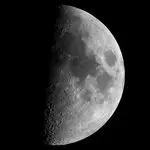



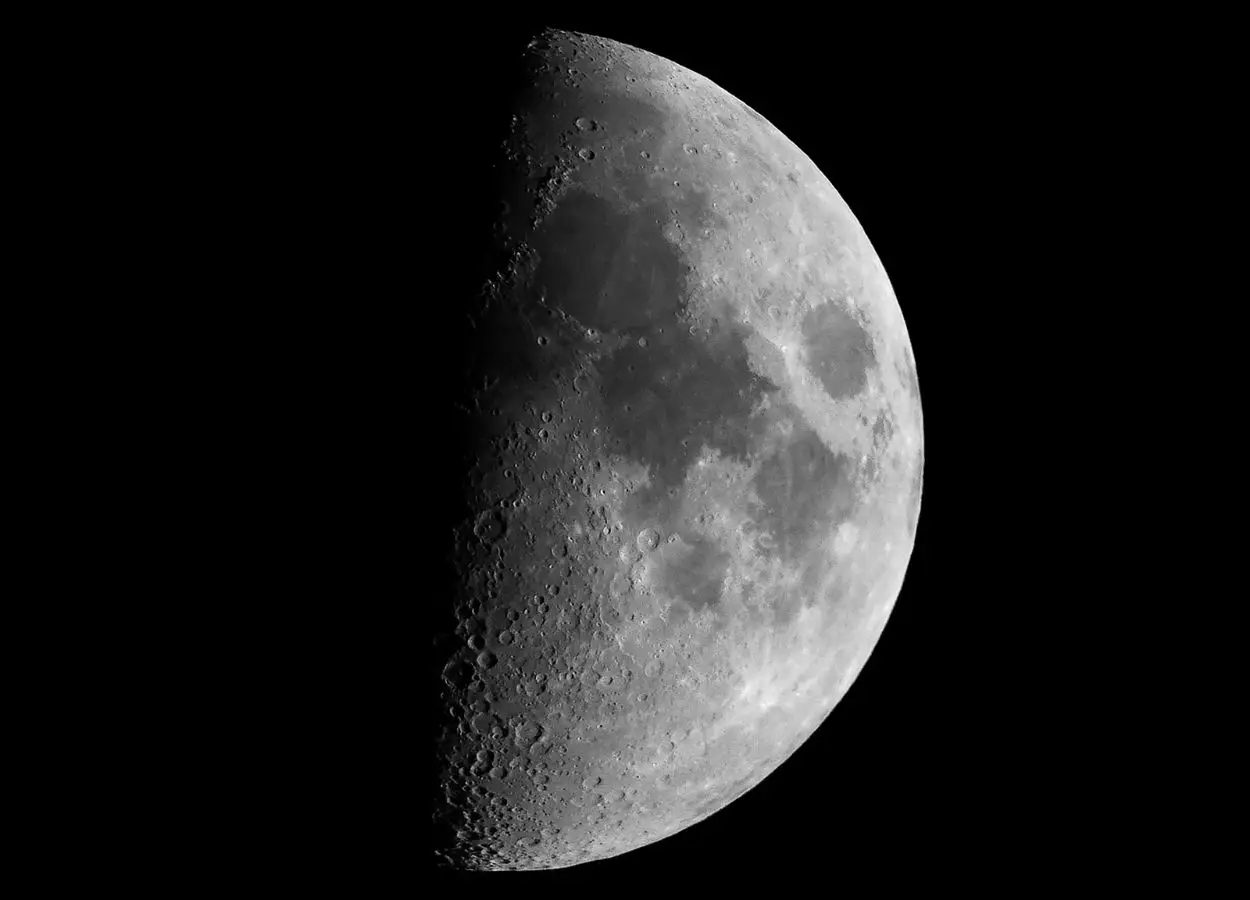
The first-quarter Moon of Jumada Al-Ula 1448 AH appeared over Saudi Arabia’s Northern Borders Region on Sunday evening, providing skywatchers with an opportunity to observe lunar features and capture images of the Moon’s changing appearance.
Table Of Content
Adnan Khalifa, a member of the Astronomy and Space Club, said the Moon reached its first-quarter phase at 7:13 p.m. Saudi time. At this stage of its monthly cycle, sunlight illuminates half of the Moon’s visible disk, while the remaining portion appears dark from Earth.
The phase occurs when the Moon has travelled approximately one-quarter of its orbital cycle since the new Moon. Its position in the sky is roughly 90 degrees from the Sun, creating the characteristic half-lit appearance associated with the first quarter.
The event offered astronomy enthusiasts an opportunity to explore the Moon’s surface, including its craters, elevated terrain and mountain ranges. The contrast between illuminated and shadowed areas makes this phase particularly suitable for observations using binoculars and telescopes.
Light and shadow reveal lunar details
Khalifa explained that the first-quarter phase is especially useful for examining the Moon’s surface because sunlight strikes the terrain at an angle near the boundary separating the bright and dark portions of the lunar disk.
This boundary, known as the terminator, produces pronounced shadows across craters, highlands and mountain ranges. The resulting contrast can make surface features easier to distinguish than when the Moon is more fully illuminated.
For amateur astronomers, the phase provides favourable conditions for both visual observation and lunar photography. Binoculars can reveal broad patterns on the surface, while telescopes allow observers to examine smaller features in greater detail, depending on the equipment and viewing conditions.
The appearance of these features changes as the Moon moves along its orbit. As the angle between the Sun, Earth and Moon shifts, the boundary between illuminated and dark terrain advances across the lunar surface, changing which craters and elevations are most clearly visible.
Moon remains visible after sunset
During the first-quarter phase, the Moon generally appears high in the evening sky and can remain visible for several hours after sunset. Khalifa said it would be observable into the early part of the night before setting at around midnight.
Over the following days, the illuminated portion visible from Earth will continue to increase as the Moon approaches its full phase. This gradual change provides a useful opportunity for observers to follow the lunar cycle and compare the appearance of surface features under different lighting conditions.
The first-quarter phase is one of several principal stages in the Moon’s monthly cycle. These phases result from changes in the relative positions of the Sun, Earth and Moon, rather than from the Earth’s shadow falling across the Moon. Earth’s shadow is responsible for lunar eclipses, which occur only under specific alignment conditions.
Astronomy activities encourage public engagement
Khalifa said observing the Moon’s phases can help improve public understanding of astronomy and the celestial movements that shape the night sky. He also encouraged enthusiasts to photograph astronomical objects and learn more about the relationship between the Moon’s orbit and its changing appearance.
Regular lunar observation can help beginners identify prominent surface features and understand how illumination changes throughout the month. It also provides an accessible starting point for exploring wider astronomical subjects, including planetary motion and the geometry of the solar system.
The appearance of the first-quarter Moon over the Northern Borders Region offered a practical opportunity for residents and astronomy enthusiasts to engage with these phenomena through observation and photography.




No Comment! Be the first one.